Large cylindrical African millipede; one of the largest living millipede species.
Giant African Millipede
Giant African Millipede
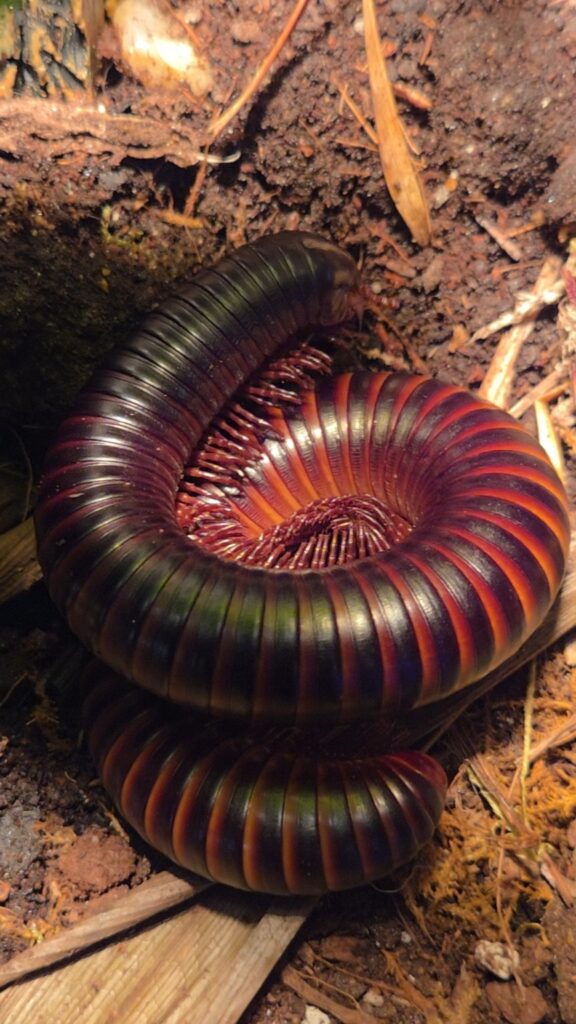
Giant African Millipede — Archispirostreptus gigas
Collection record
Current stats
SexNot recorded
DOB / Hatch dateNot recorded
WeightNot recorded
Morph / TraitsNot recorded
Lineage / PairingNot recorded
Record notesNot recorded
Published biology & practical care
Field-guide notes
Tropical East Africa; forest-floor and soil-associated detritivore.
Commonly about 18–25 cm, with large adults capable of exceeding that range.
Large glossy dark-brown to black body with many ring-like segments and paired legs on most trunk segments.
Mostly calm, slow-moving detritivore that burrows readily in loose substrate and may retreat below ground when conditions dry.
72–80 °F (22–27 °C) practical captive range; avoid cold drafts and overheating.
Humid substrate with ventilation. Keep deeper layers moist but not waterlogged and allow some surface variation.
Deep, loose, pesticide-free decomposed hardwood/leaf substrate; depth should allow full-body burrowing.
Primarily decomposing leaf litter and rotten hardwood, with vegetable supplements.
Provide calcium-rich material; protein is supplemental rather than the staple.
Requires mature, deep substrate and long-term stability; eggs and early stages develop within the substrate.
Slow relative to many smaller detritivorous invertebrates.
Excellent decomposer in a dedicated large enclosure, but not appropriate as a routine cleanup crew in small vivaria.
Intermediate because of size, substrate depth, long lifespan, and sensitivity to poor substrate conditions.
Giant African millipedes can create burrows related to foraging and moisture regulation.
Laurarium observations
Our husbandry notes
No Laurarium husbandry observations have been published for this animal yet.
Published biology & practical care
Field-guide notes
Large cylindrical African millipede; one of the largest living millipede species.
Tropical East Africa; forest-floor and soil-associated detritivore.
Commonly about 18–25 cm, with large adults capable of exceeding that range.
Large glossy dark-brown to black body with many ring-like segments and paired legs on most trunk segments.
Mostly calm, slow-moving detritivore that burrows readily in loose substrate and may retreat below ground when conditions dry.
72–80 °F (22–27 °C) practical captive range; avoid cold drafts and overheating.
Humid substrate with ventilation. Keep deeper layers moist but not waterlogged and allow some surface variation.
Deep, loose, pesticide-free decomposed hardwood/leaf substrate; depth should allow full-body burrowing.
Primarily decomposing leaf litter and rotten hardwood, with vegetable supplements.
Provide calcium-rich material; protein is supplemental rather than the staple.
Requires mature, deep substrate and long-term stability; eggs and early stages develop within the substrate.
Slow relative to many smaller detritivorous invertebrates.
Excellent decomposer in a dedicated large enclosure, but not appropriate as a routine cleanup crew in small vivaria.
Intermediate because of size, substrate depth, long lifespan, and sensitivity to poor substrate conditions.
Giant African millipedes can create burrows related to foraging and moisture regulation.
Laurarium observations
Our husbandry notes
No Laurarium husbandry observations have been published for this animal yet.