Large southeastern U.S. spirobolid millipede commonly called the Florida Ivory.
Florida Ivory Millipede
Florida Ivory Millipede
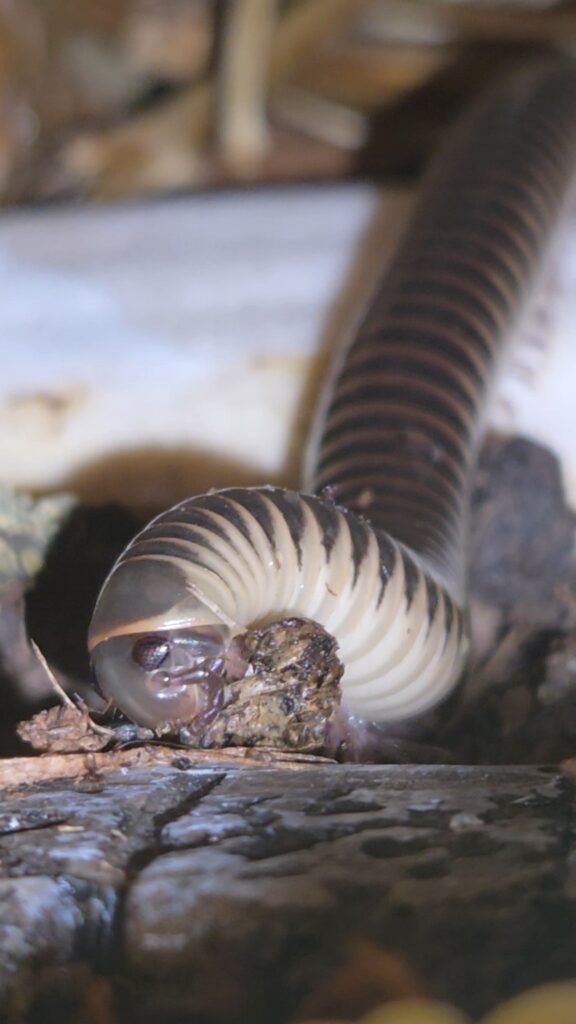
Florida Ivory Millipede — Chicobolus spinigerus
Collection record
Current stats
SexNot recorded
DOB / Hatch dateNot recorded
WeightNot recorded
Morph / TraitsNot recorded
Lineage / PairingNot recorded
Record notesNot recorded
Published biology & practical care
Field-guide notes
Native to the southeastern United States, especially Florida and surrounding Gulf/Southeast habitats.
Often around 8–12 cm in captivity; verify Laurarium adult measurements for a collection-specific range.
Ivory/cream banding contrasted with darker brown-to-black body segments.
Calm detritivore that spends substantial time in leaf litter, under cover, and within the upper substrate.
70–78 °F (21–26 °C) practical captive range.
Moderately humid substrate with good ventilation; avoid both desiccation and stagnant saturation.
Deep organic soil with abundant decomposed hardwood and leaf litter.
Decaying hardwood and leaves are staple foods, supplemented with vegetables.
Keep a calcium source available; protein supplementation should be modest.
Stable mature substrate and undisturbed depth are important for reproduction and juvenile development.
Moderate to slow; use Laurarium records for any published colony-growth claim.
Useful decomposer in a dedicated invertebrate setup; size makes it unsuitable for many small planted vivaria.
Beginner to intermediate.
This species is native to the U.S. Southeast rather than being an imported tropical millipede.
Laurarium observations
Our husbandry notes
No Laurarium husbandry observations have been published for this animal yet.
Published biology & practical care
Field-guide notes
Large southeastern U.S. spirobolid millipede commonly called the Florida Ivory.
Native to the southeastern United States, especially Florida and surrounding Gulf/Southeast habitats.
Often around 8–12 cm in captivity; verify Laurarium adult measurements for a collection-specific range.
Ivory/cream banding contrasted with darker brown-to-black body segments.
Calm detritivore that spends substantial time in leaf litter, under cover, and within the upper substrate.
70–78 °F (21–26 °C) practical captive range.
Moderately humid substrate with good ventilation; avoid both desiccation and stagnant saturation.
Deep organic soil with abundant decomposed hardwood and leaf litter.
Decaying hardwood and leaves are staple foods, supplemented with vegetables.
Keep a calcium source available; protein supplementation should be modest.
Stable mature substrate and undisturbed depth are important for reproduction and juvenile development.
Moderate to slow; use Laurarium records for any published colony-growth claim.
Useful decomposer in a dedicated invertebrate setup; size makes it unsuitable for many small planted vivaria.
Beginner to intermediate.
This species is native to the U.S. Southeast rather than being an imported tropical millipede.
Laurarium observations
Our husbandry notes
No Laurarium husbandry observations have been published for this animal yet.