Arid-land darkling beetle known for a blue waxy coating and dramatic tonic-immobility “death feigning.”
Blue Death-Feigning Beetle
Blue Death Feigning Beetle
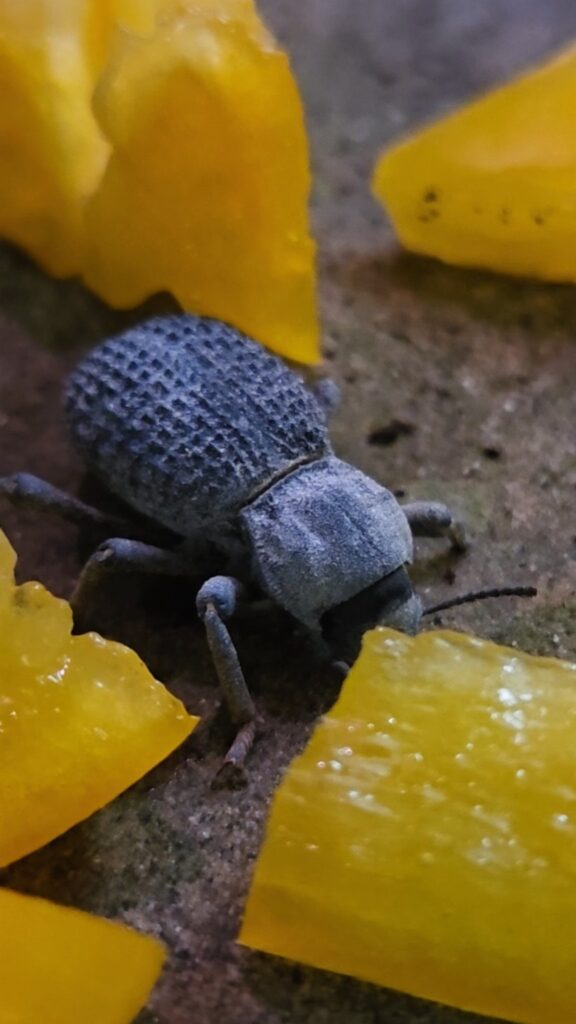
Blue Death-Feigning Beetle — Asbolus verrucosus
Collection record
Current stats
SexNot recorded
DOB / Hatch dateNot recorded
WeightNot recorded
Morph / TraitsNot recorded
Lineage / PairingNot recorded
Record notesNot recorded
Published biology & practical care
Field-guide notes
Southwestern North American desert environments.
Roughly 18–22 mm for typical adults.
Powdery blue to blue-gray surface caused by a waxy cuticular coating; darker when wet.
Diurnal to crepuscular surface-active beetle; freezes and curls defensively when disturbed.
70–85 °F (21–29 °C), with a warmer daytime zone and no requirement for tropical humidity.
Arid to dry. Keep the adult enclosure dry with good ventilation; provide moisture mainly through food and controlled micro-sites.
Dry sand/soil mix with rocks, bark, and secure hides.
Omnivorous scavenger: dry plant material, vegetables, small amounts of fruit, and occasional protein sources.
No special calcium requirement comparable to millipedes/isopods; offer a varied omnivorous diet with modest protein.
Adult care is straightforward, but successful larval rearing is substantially more demanding and benefits from controlled substrate moisture/temperature.
Slow/technical in captivity compared with simple adult maintenance.
Primarily a display/scavenger beetle for arid setups, not a high-output cleanup-crew species.
Beginner for adults; advanced for breeding.
The blue appearance is structural/waxy rather than blue pigment, and handling or moisture can temporarily darken the surface.
Laurarium observations
Our husbandry notes
No Laurarium husbandry observations have been published for this animal yet.
Published biology & practical care
Field-guide notes
Arid-land darkling beetle known for a blue waxy coating and dramatic tonic-immobility “death feigning.”
Southwestern North American desert environments.
Roughly 18–22 mm for typical adults.
Powdery blue to blue-gray surface caused by a waxy cuticular coating; darker when wet.
Diurnal to crepuscular surface-active beetle; freezes and curls defensively when disturbed.
70–85 °F (21–29 °C), with a warmer daytime zone and no requirement for tropical humidity.
Arid to dry. Keep the adult enclosure dry with good ventilation; provide moisture mainly through food and controlled micro-sites.
Dry sand/soil mix with rocks, bark, and secure hides.
Omnivorous scavenger: dry plant material, vegetables, small amounts of fruit, and occasional protein sources.
No special calcium requirement comparable to millipedes/isopods; offer a varied omnivorous diet with modest protein.
Adult care is straightforward, but successful larval rearing is substantially more demanding and benefits from controlled substrate moisture/temperature.
Slow/technical in captivity compared with simple adult maintenance.
Primarily a display/scavenger beetle for arid setups, not a high-output cleanup-crew species.
Beginner for adults; advanced for breeding.
The blue appearance is structural/waxy rather than blue pigment, and handling or moisture can temporarily darken the surface.
Laurarium observations
Our husbandry notes
No Laurarium husbandry observations have been published for this animal yet.