Porcellio scaber hobby morph “Orange Koi”.
Isopod Culture
Orange Koi
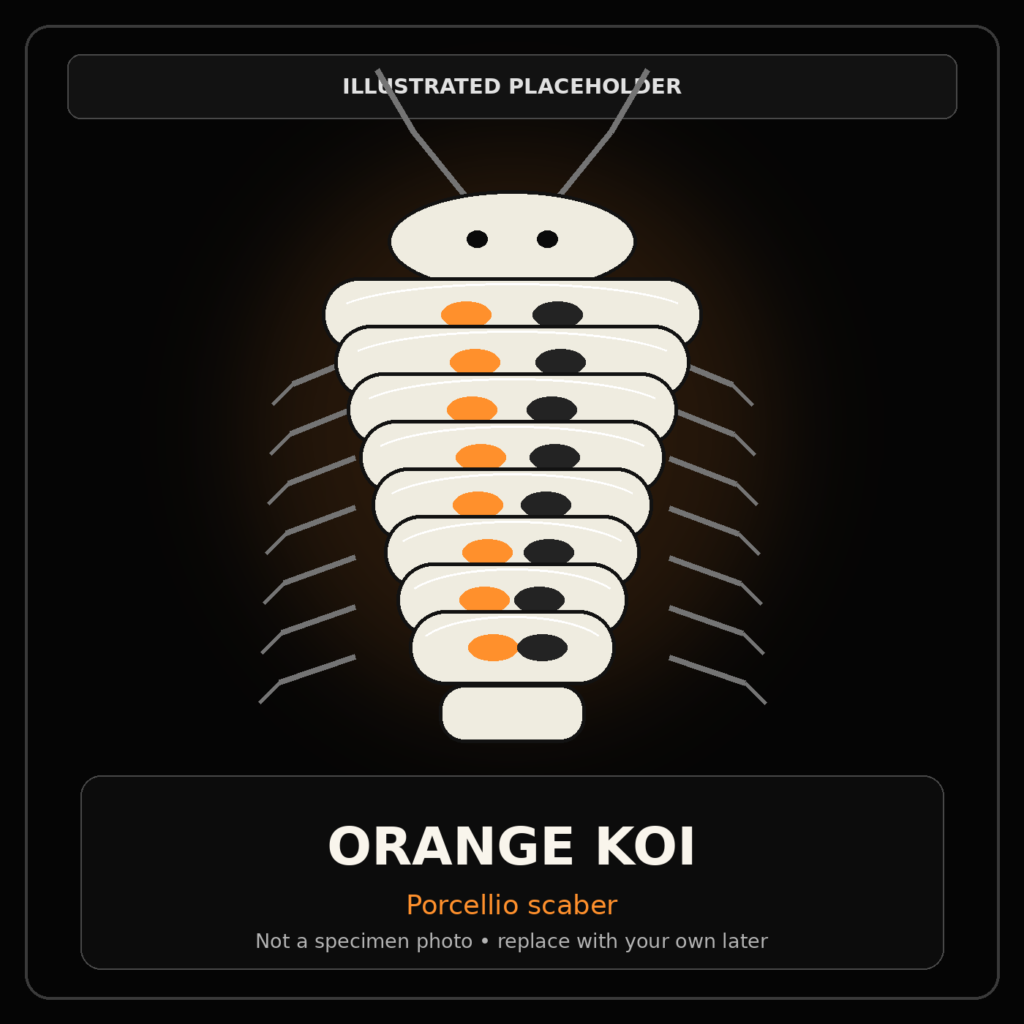 Laurarium photo
 A colorful Porcellio scaber morph with active cleanup-crew behavior.
Published biological information is separated below from Laurarium-specific observations and collection records.
Collection record
Culture statusNot recorded
AvailabilityNot recorded
Culture countNot recorded
ID confidenceNot recorded
Source-stock provenance
Collection origin
SourceJungle Fever
LocationHuntertown, IN
AcquiredApril 2026
Founding quantity10
This records Laurarium’s source stock/acquisition history. It is not a biological parent-pair or genetic-lineage claim.
Save or compare
Explore this profile
Published biology & practical care
Field-guide notes
Captive hobby morph of Porcellio scaber; collection profile focuses on the Laurarium culture rather than claiming a locality.
Orange-to-peach patterning over a variable pale and darker background.
Active surface-forager that also uses bark, leaf litter, and the moist side of the culture.
Room-temperature culture conditions with protection from prolonged overheating.
Maintain a clear moisture gradient: one reliably moist refuge and one better-ventilated drier area.
Organic substrate with decomposed leaves and hardwood plus cork/bark cover.
Leaf litter and decayed wood as staples with vegetable and prepared invertebrate supplements.
Keep calcium available and offer modest supplemental protein.
Generally establishes readily when moisture, cover, calcium, and food remain stable.
Moderate to fast once established; Laurarium colony records should be used for collection-specific claims.
Useful cleanup-crew species when a backup culture is maintained.
Beginner.
Orange Koi is a hobby color morph, so individual pattern and orange intensity can vary within the culture.
Laurarium observations
Our colony notes
No Laurarium husbandry observations have been published for this culture yet.
Laurarium Colony Pulse
Current culture status
Last checked: September 19, 2026
The small container was one of the healthiest colonies; the long container had no visible live isopods before being reinforced from the thriving small bin.
Long🟡 Stable / RebuildingNo live isopods were visible before reinforcement. Overstock/material from the thriving small bin was transferred in.
Small🔥 ThrivingExceptionally healthy, very high population, used as the donor colony to strengthen the long bin.
Next-check focus: Watch the rebuilt long bin for visible activity while protecting the small bin as the donor colony.